How Meeting Room Conflicts Kill Productivity

When Meeting Rooms Create Daily Friction
Meeting rooms are intended to be shared assets that enable teams to collaborate effectively. They are supposed to offer a controlled environment where discussions can happen without distraction, ideas can be explored deeply, and decisions can be made with clarity. Yet in many workplaces, these spaces generate more friction than focus. Instead of supporting productivity, meeting rooms become sources of tension, uncertainty, and inefficiency.
This friction begins when meeting rooms are treated casually rather than deliberately. Without a clear system governing usage, rooms operate on assumptions. A door left open suggests availability. A recurring meeting implies ownership. A lack of visible structure encourages employees to make judgment calls, often at the expense of others. What starts as convenience slowly turns into conflict.
As more teams rely on meetings to coordinate work, pressure on shared spaces increases. When demand rises without corresponding structure, competition emerges. Employees adapt by arriving early, holding rooms longer than necessary, or avoiding releasing spaces even when meetings end early. These behaviors are not driven by bad intent but by uncertainty. People protect what they fear losing.
Over time, this creates an environment where shared resources feel scarce, even when they are not. Meeting rooms become contested territory rather than neutral ground. Conversations begin with negotiations over space instead of agendas. The emotional tone of meetings shifts before discussions even start, setting a negative precedent that affects outcomes.
This kind of friction rarely escalates into open conflict, which is why it persists. Instead, it becomes embedded in daily routines. Teams normalize inefficiency, accept delays as unavoidable, and stop expecting meetings to run smoothly. Productivity declines quietly, hidden beneath the surface of a busy workplace.
How Disorganized Meetings Hurt Daily Work
Meetings are operational tools. They exist to align teams, solve problems, and move work forward. For meetings to serve this purpose, they must be intentional, structured, and uninterrupted. Meeting room conflicts directly undermine these conditions, turning productive sessions into fragmented exchanges.
When meetings are not anchored to clearly booked spaces, they become vulnerable to disruption. A late start immediately reduces effectiveness. Participants repeat context, lose focus, and struggle to regain momentum. Even a short delay can derail the flow of discussion, especially when meetings are tightly scheduled.
Interruptions are even more damaging. When a team is forced to end early because another group needs the room, conversations are rushed. Decisions are postponed, nuances are missed, and accountability becomes unclear. The meeting technically happens, but its purpose is only partially fulfilled.
These disruptions have downstream effects. Incomplete meetings lead to follow-up discussions, clarification messages, and additional alignment sessions. What should have been resolved in one focused conversation spills across multiple touchpoints. This increases the total time spent on the same topic while reducing clarity.
There is also a planning cost. When employees cannot rely on meeting rooms, they plan defensively. Agendas are shortened, participant lists are reduced, and discussions are simplified to fit uncertain timeframes. While this may seem efficient, it often leads to oversights and misalignment that surface later as rework.
Operational efficiency depends on predictability. Meeting room conflicts introduce variability into schedules, workflows, and outcomes. This variability makes execution harder, timelines less reliable, and productivity inconsistent across teams.

The Mental and Emotional Impact of Constant Room Conflicts
Beyond operational impact, meeting room conflicts impose a cognitive and emotional burden on employees. Productivity is closely tied to mental clarity, and clarity is difficult to maintain in environments filled with uncertainty and interruption.
When employees are unsure whether a meeting space will be available, part of their attention is diverted from the task at hand. This creates a background level of stress that reduces focus even before meetings begin. Preparation suffers as people multitask between content and logistics.
Repeated exposure to these conditions leads to cognitive fatigue. Constantly adjusting plans, renegotiating space, and recovering from interruptions consumes mental energy. This energy is finite. When it is spent on logistics, less remains for analysis, creativity, and problem-solving.
Emotionally, competition over shared spaces erodes goodwill. Teams may not openly express frustration, but resentment accumulates. Subtle behaviors—overstaying meetings, ignoring booking norms, or avoiding collaboration—become coping mechanisms. These behaviors strain relationships and weaken trust between teams.
Morale also suffers. When employees feel their time is not respected, motivation declines. Meetings begin to feel like obstacles rather than opportunities. Participation becomes passive, engagement drops, and collaboration loses its effectiveness.
Perhaps most damaging is the normalization of inefficiency. When employees expect meetings to be disrupted, they lower their standards. They stop pushing for clarity, stop expecting outcomes, and stop believing that meetings can be productive. This mindset shift has long-term consequences for organizational performance.
Why Meeting Room Issues Slow Decisions and Execution
At their core, meetings exist to drive decisions. Whether it’s approving plans, resolving issues, or aligning priorities, meetings are the mechanisms through which organizations convert discussion into action. Meeting room conflicts weaken this mechanism, slowing decision-making and execution.
When meetings are delayed or cut short, decisions are deferred. Stakeholders leave without resolution, waiting for the next opportunity to reconvene. This delay creates bottlenecks, especially in environments where decisions are interdependent. One unresolved issue can stall multiple workstreams.
As delays accumulate, teams become cautious. They hesitate to act without full alignment, slowing execution. Alternatively, they move forward with assumptions, increasing the risk of errors and rework. Both outcomes reduce efficiency and increase costs.
Meeting room conflicts also encourage reactive scheduling. Instead of planning meetings based on readiness and purpose, teams schedule around availability. This prioritizes convenience over effectiveness, leading to poorly timed discussions that fail to include the right context or preparation.
Over time, decision-making becomes fragmented. Instead of clear outcomes from structured meetings, decisions are pieced together through emails, informal conversations, and follow-ups. This diffusion of responsibility weakens accountability and clarity.
Execution speed suffers as a result. Projects move forward in fits and starts, driven by availability rather than strategy. The organization appears active but lacks momentum. This is not due to a lack of capability, but due to an environment that disrupts the decision-making process at its foundation.
Signs Your Workplace Has Meeting Room Chaos
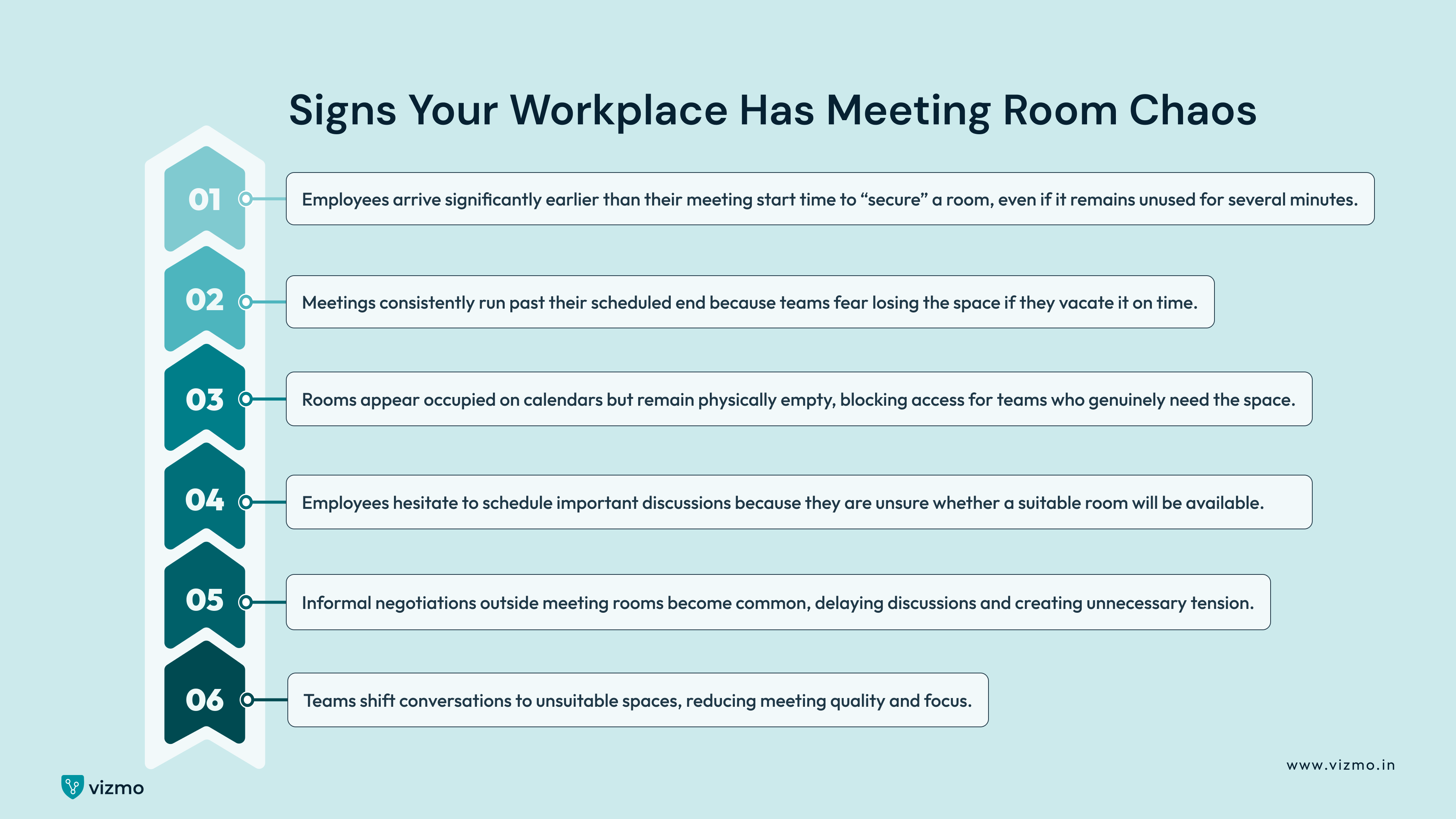
When meeting rooms are not booked intentionally, certain patterns begin to appear across the workplace. These behaviors are not personality-driven; they are symptoms of an environment where structure is missing. Recognizing them helps organizations understand how deeply meeting room conflicts affect productivity.
- Employees arrive significantly earlier than their meeting start time to “secure” a room, even if it remains unused for several minutes.
- Meetings consistently run past their scheduled end because teams fear losing the space if they vacate it on time.
- Rooms appear occupied on calendars but remain physically empty, blocking access for teams who genuinely need the space.
- Employees hesitate to schedule important discussions because they are unsure whether a suitable room will be available.
- Informal negotiations outside meeting rooms become common, delaying discussions and creating unnecessary tension.
- Teams shift conversations to unsuitable spaces, reducing meeting quality and focus.
These behaviors signal more than inconvenience. They indicate lost trust in shared systems and a breakdown in how time and space are respected. Productivity declines not because people don’t want to collaborate, but because collaboration becomes unnecessarily difficult.
Reducing Conflict with Clear Booking and Better Visibility
Meeting room conflicts are not an inevitable byproduct of collaboration. They are the result of ambiguity. When organizations introduce discipline and visibility into how meeting spaces are used, productivity improves measurably.
Intentional booking creates clarity. When meetings are scheduled with defined start and end times, expectations are set. Teams know when spaces are available, and transitions become smoother. This predictability allows meetings to start on time and run their full course without interruption.
Visibility also plays a critical role. When availability is clear, employees no longer need to compete for rooms or make assumptions. Decisions about scheduling become straightforward, reducing stress and friction. Trust in the system replaces informal negotiations.
Discipline reinforces respect. When booking norms are followed, meetings end on time, and spaces are released as planned. This creates a culture where shared resources are treated responsibly. Over time, this discipline extends beyond meeting rooms into broader work practices.
Perhaps most importantly, structured booking restores confidence in meetings. Employees arrive prepared, knowing they will have uninterrupted time. Discussions become deeper, decisions clearer, and outcomes more actionable. Meetings regain their role as productivity drivers rather than productivity drains.
Eliminating the need to fight over meeting rooms removes a persistent source of friction from the workday. It frees up mental energy, restores focus, and enables teams to collaborate effectively. Productivity is not increased by adding more meetings or working longer hours—it is increased by removing obstacles that prevent work from flowing smoothly.
In the end, how an organization manages its meeting rooms reflects how it values time, focus, and collaboration. When meeting rooms are booked with intention rather than fought over by chance, productivity stops leaking away and begins to compound in meaningful ways.
What Improves When Meeting Rooms Are Used Intentionally
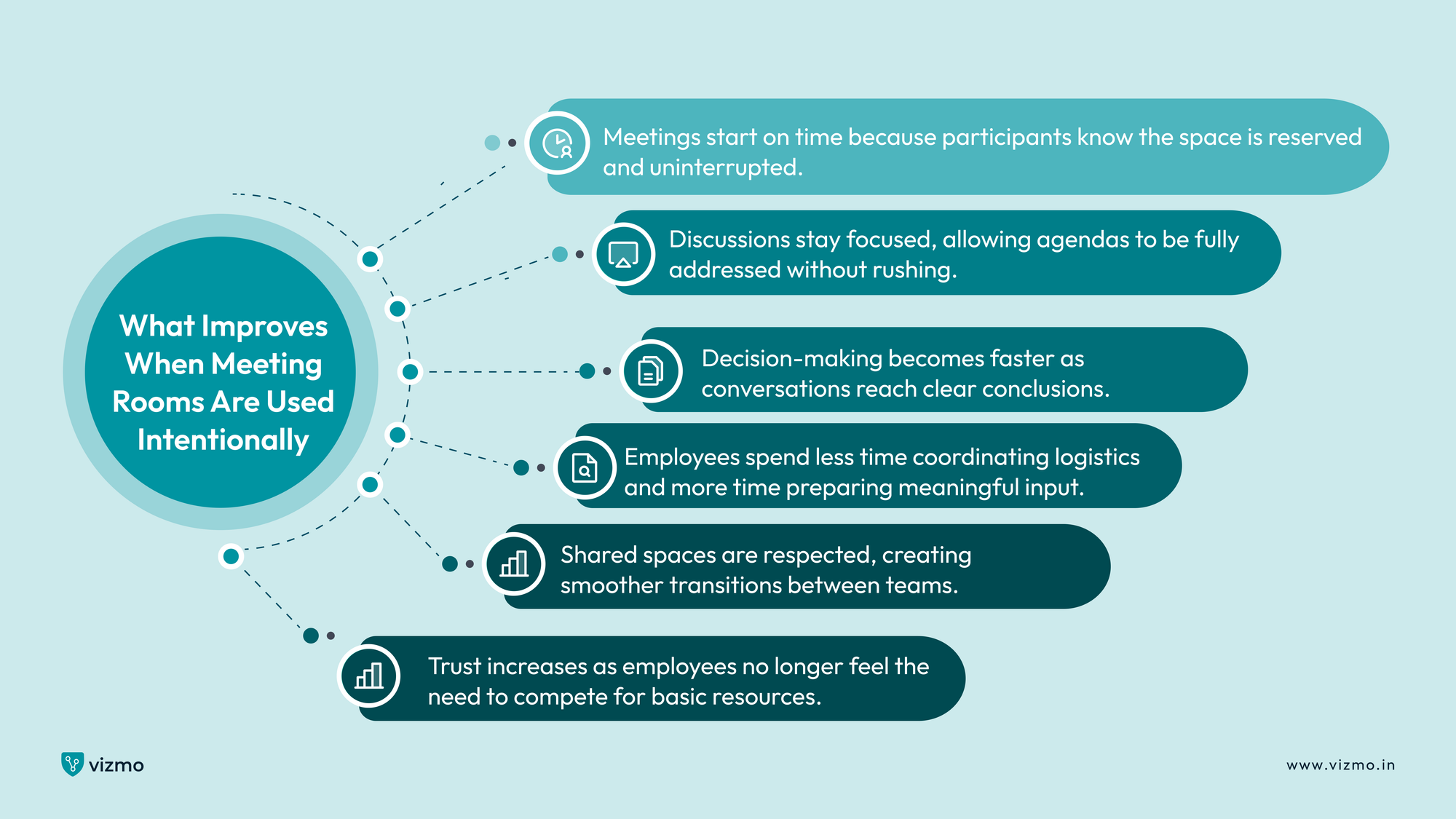
When meeting rooms are treated as planned resources rather than opportunistic finds, the workplace dynamic shifts noticeably. Productivity improves not through effort, but through clarity. The absence of conflict creates space for better thinking, better discussions, and better outcomes.
- Meetings start on time because participants know the space is reserved and uninterrupted.
- Discussions stay focused, allowing agendas to be fully addressed without rushing.
- Decision-making becomes faster as conversations reach clear conclusions.
- Employees spend less time coordinating logistics and more time preparing meaningful input.
- Shared spaces are respected, creating smoother transitions between teams.
- Trust increases as employees no longer feel the need to compete for basic resources.
Intentional booking removes friction from daily operations. It replaces uncertainty with predictability and transforms meeting rooms from productivity drains into productivity enablers. The result is not just better meetings, but a calmer, more disciplined, and more effective work environment.
Conclusion: Productivity Grows When Friction Is Removed
Meeting room conflicts rarely appear on productivity reports, yet their impact is felt across every layer of the organization. They interrupt focus, slow decisions, and quietly normalize inefficiency. When teams are forced to fight for space, collaboration becomes harder than it needs to be, and progress stalls not because of lack of effort, but because of constant friction.
The difference between productive workplaces and frustrated ones is not the number of meetings held, but how reliably those meetings can happen. When meeting rooms are treated as intentional, bookable resources rather than informal conveniences, work regains its rhythm. Conversations become purposeful, time is respected, and teams can focus fully on outcomes instead of logistics.
Eliminating meeting room conflict is not about enforcing rules—it’s about creating an environment where work can move forward without resistance. When uncertainty is removed and clarity takes its place, productivity stops being something teams struggle to achieve and starts becoming a natural result of how the workplace is designed.
In the end, organizations don’t lose productivity because people aren’t working hard enough. They lose it because small, everyday obstacles go unaddressed. Fixing how meeting rooms are used is one of the simplest ways to remove those obstacles—and one of the most powerful ways to let productivity compound.