Door Access Control Systems for Factories: A Complete Guide

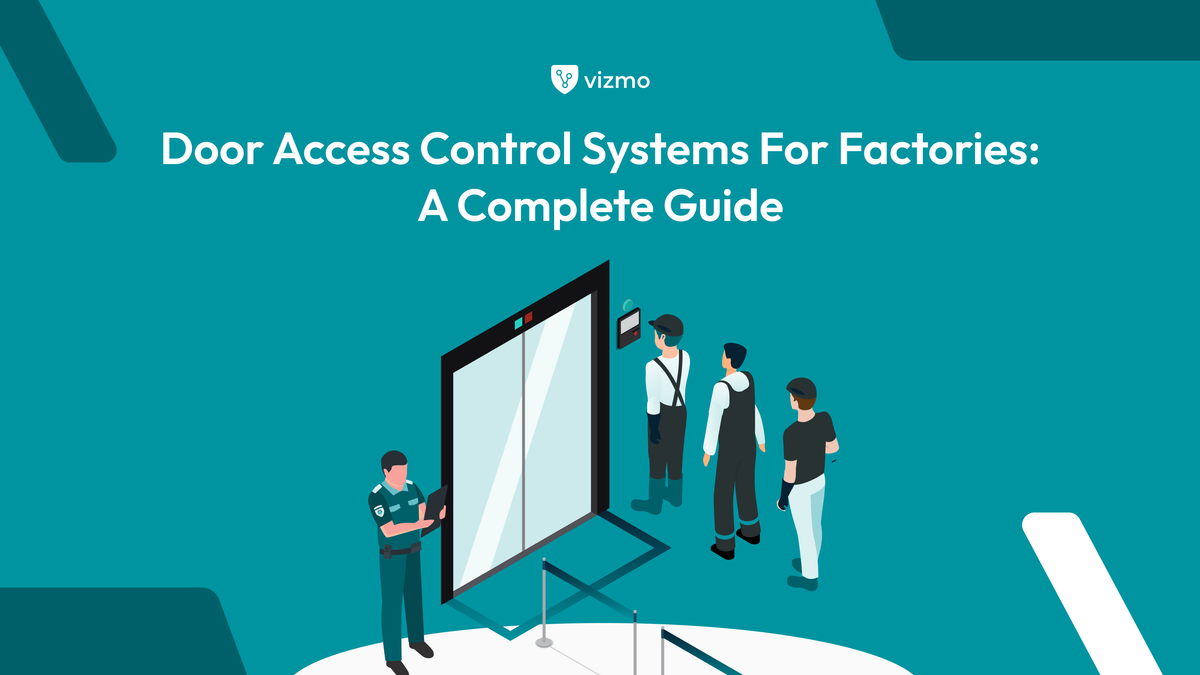
A factory with 500 workers, rotating shifts, and dozens of contractors entering every day cannot rely on a gate register and a security guard's memory. When the production floor, chemical storage, and server room all sit inside the same premises, leaving access decisions to manual checks creates gaps that are expensive to fix after the fact.
Door access control systems give factory security teams a way to manage who enters which area, when, and on what authority — automatically. This guide covers how they work, which technologies fit which factory environments, and what to look for when choosing a system for your facility.
What Is a Door Access Control System?
A door access control system is a security system that decides who can enter a specific area of a facility — and logs every entry and exit automatically. It replaces physical keys and manual registers with digital credentials: RFID cards, biometric scans, or facial recognition. When a credential is presented, the system verifies it against a permission database, unlocks the door if authorized, and records the event with a timestamp.
In a factory context, this means every door — from the main gate to the production floor to the server room — operates on a controlled, auditable basis without requiring a security guard at each point.
Why Factories Need Access Control Systems
Factories face a different set of security challenges than office buildings. The workforce is larger, more varied, and operates across multiple shifts. Contractors and vendors move through the same premises as full-time employees. And the consequences of unauthorized access — to a chemical store, a high-voltage zone, or a restricted production line — go beyond data loss into physical safety risk.
Here is what goes wrong without a structured access control system:
• Contractors who completed a project months ago still have active site access because no one revoked their credentials
• Employees from one shift or department enter restricted zones during off-hours with no record of the event
• Compliance audits require entry logs that don't exist in a usable format — only partial paper registers
• A contractor is injured in a zone they had no authorization to enter, and there is no documentation to establish what happened
• Tailgating at main gates allows multiple people to enter on a single credential scan
An industrial access control system eliminates each of these gaps by making entry permission explicit, time-bound, and automatically logged.
How Door Access Control Systems Work in Factories
Every access control system follows the same core sequence, regardless of the technology used:
• Credential presented — employee or visitor presents an RFID card, biometric scan, or mobile credential at the reader
• Identity verified — the reader confirms the credential is valid and matches a registered user
• Permission validated — the system checks whether that user is authorized to enter that specific door at that specific time
• Door unlocked — if both checks pass, the electromagnetic lock releases and entry is permitted
• Event logged — the entry is recorded with a timestamp, user ID, door location, and credential type
If verification fails at any step — expired credential, wrong time window, unauthorized zone — the door stays locked and security receives an alert. No manual intervention required.
Types of Door Access Control Systems for Factories
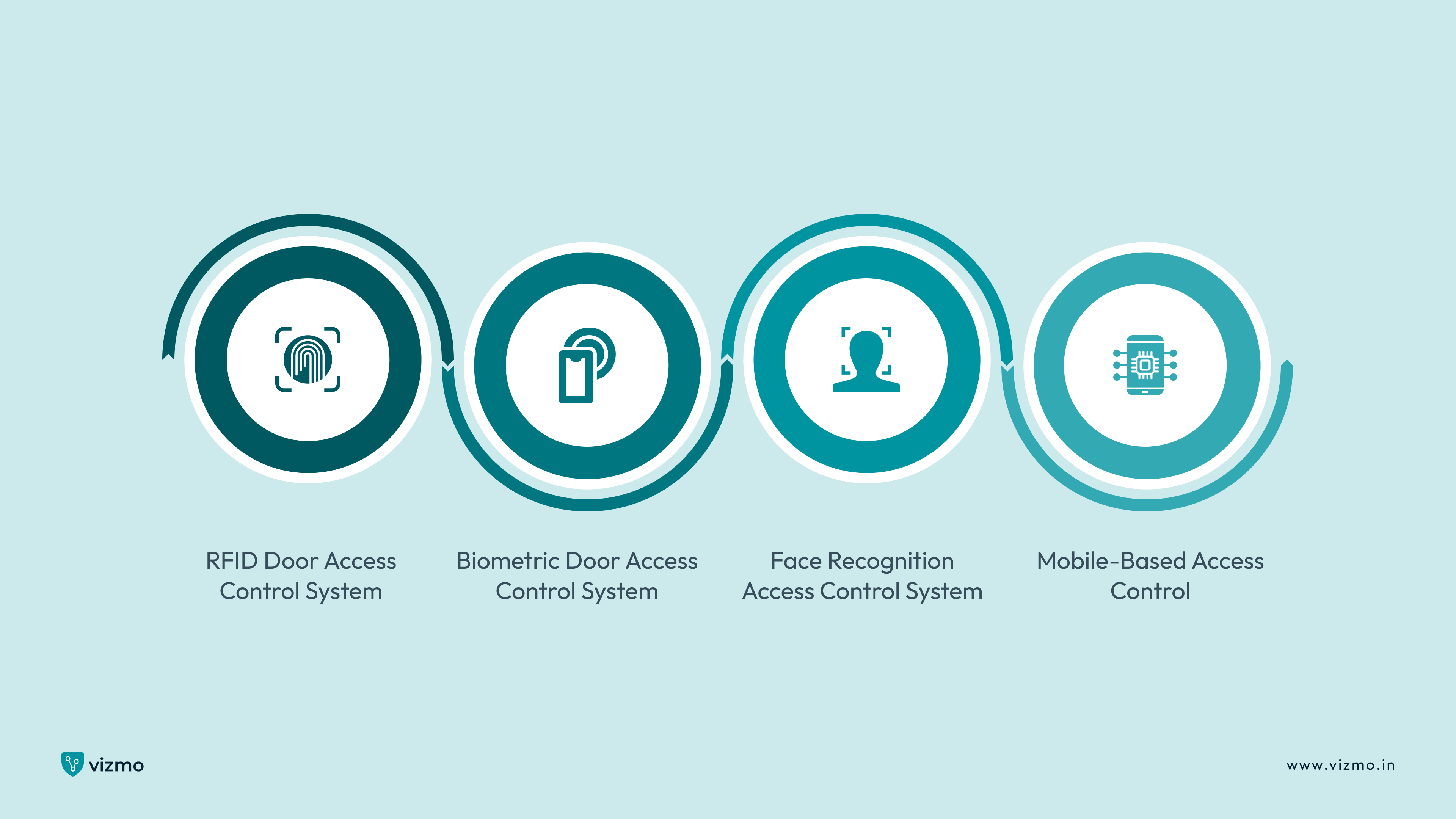
RFID Door Access Control System
RFID-based systems use proximity cards or tags that communicate with a reader when held within range — typically 5 to 10 cm. Employees carry an RFID card that stores their credentials. The system reads it in under a second, making RFID well-suited for high-traffic entry points like factory gates and warehouse doors where speed matters.
RFID works well for shift-based access — cards can be programmed to allow entry only during a specific employee's shift window, automatically locking out credentials outside their scheduled hours. The limitation is that cards can be shared or lost, and there is no guarantee the person presenting the card is the person it belongs to.
Biometric Door Access Control System
Biometric systems verify identity using a physical characteristic unique to the individual — most commonly a fingerprint. Because the credential cannot be transferred, biometric authentication eliminates buddy punching and shared access entirely. Only the registered employee can gain entry.
Fingerprint access control is widely used in manufacturing for production floor entry and attendance tracking because it creates a clean audit trail tied to the individual. The consideration in factory environments is contamination — dusty or oily hands can affect scan accuracy, which is why sensor quality and regular maintenance matter when deploying in industrial settings.
Face Recognition Access Control System
Face recognition access control is the most secure and operationally efficient option available for factory environments today. Vizmo's facial recognition terminal authenticates identity in under a second without requiring the employee to remove gloves, swipe a card, or touch any surface. The system identifies the individual from a distance, checks their access permissions, and logs the entry — all before they reach the door.
For factories where workers wear helmets and masks, Vizmo's system is built to handle partial occlusion — it verifies identity even when standard PPE is in place. This makes it particularly effective for high-security areas like chemical storage, R&D labs, and control rooms where touchless access and zero credential-sharing are non-negotiable.
Face recognition also removes the single biggest vulnerability in physical security: the credential that gets passed around. There is no card to share, no PIN to tell a colleague. The person in front of the camera is the credential.
Mobile-Based Access Control
Mobile credentials use a smartphone as the access device — either via Bluetooth or NFC. This works well for temporary access scenarios: a contractor arriving for a three-day job can be issued a time-limited mobile credential without issuing a physical card. When the job is done, the credential expires automatically. Simple to manage, and nothing physical to collect back.
Key Components of a Factory Access Control System
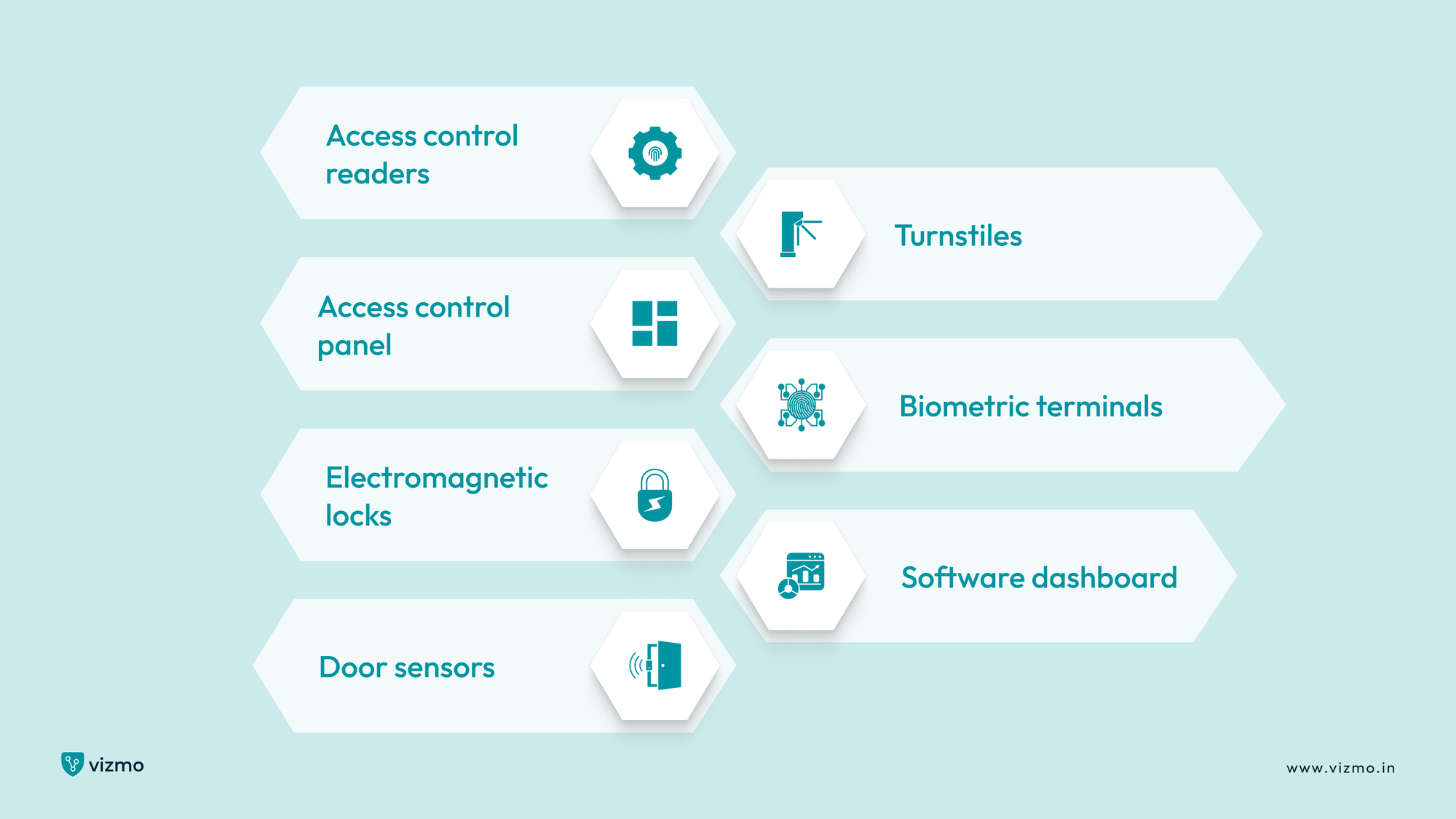
• Access control readers — the hardware at each door that reads the credential (card, fingerprint, or face)
• Access control panel — the controller that processes the credential, checks the permission database, and triggers the lock
• Electromagnetic locks — secure door locks that release only on an authorized signal from the panel
• Door sensors — detect whether a door is open or closed; alert security if a door is held open beyond an allowed time
• Turnstiles — enforce one-person-per-credential entry at main gates, preventing tailgating
• Biometric terminals — standalone units for fingerprint or face verification at high-security entry points
• Software dashboard — the central interface where security teams manage permissions, view live entry logs, set access rules, and generate reports
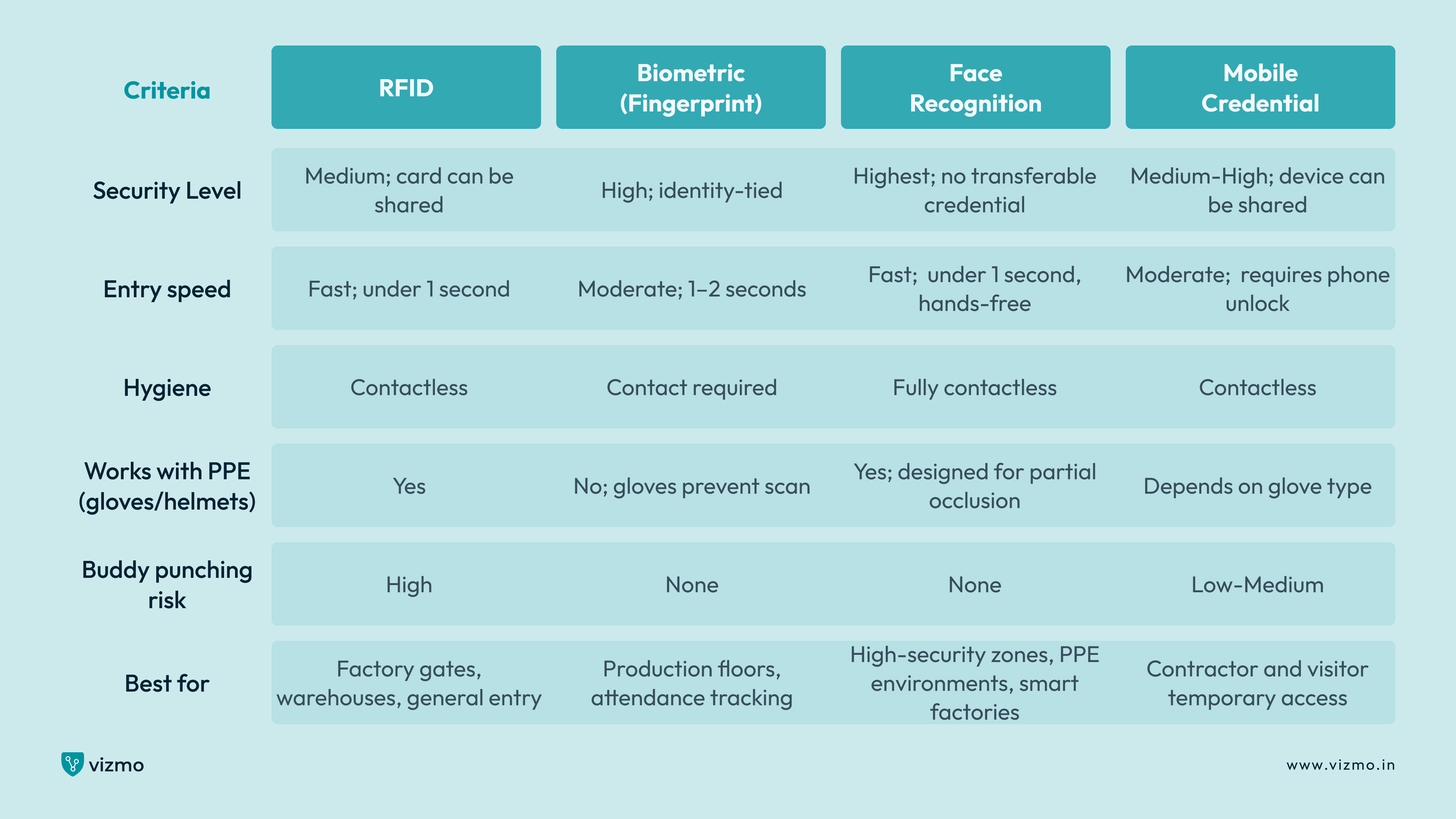
RFID vs Biometric vs Face Recognition: Which Is Right for Your Factory?
This is the question most factory security managers ask. The answer depends on what you are securing and how your workforce operates.
Benefits of Access Control Systems for Factories
• Reduces gate entry processing time from an average of 3–4 minutes to under 60 seconds with automated credential verification
• Eliminates unauthorized zone access — permission rules are enforced at the door, not by a security guard's judgment
• Automatically generates audit-ready entry logs with timestamp, user ID, and door location — no manual compilation before inspections
• Shift-based access permissions mean a night-shift employee's credentials are inactive during day hours, without any manual adjustment
• Centralized access management lets security teams add, modify, or revoke credentials for any door across any facility location from one dashboard
• Emergency lockdown can be triggered from the software dashboard, locking all or selected doors instantly across the entire facility
• Visitor and contractor access is time-limited — credentials expire automatically when the permitted window closes
• Integration with attendance systems eliminates duplicate data entry and ensures payroll records match actual entry logs
Real-World Example: Automotive Components Manufacturer, Chennai
A mid-sized automotive parts manufacturer in Chennai with approximately 700 employees and 80–100 contractor visits daily was failing compliance audits due to incomplete entry records. Contractors were issued physical access cards that were rarely collected after job completion. Three separate incidents of unauthorized access to the paint shop — a restricted zone — had occurred within six months, with no usable entry records to investigate.
After deploying Vizmo's access control system with face recognition at key entry points and RFID at general factory gates, the company moved to role-based access permissions tied to each employee and contractor's profile. Contractor credentials were configured to expire automatically at the end of each job. The paint shop and three other restricted zones were placed under face recognition-only entry.
Within 30 days: unauthorized access to restricted zones dropped to zero. The next compliance audit was completed in under two hours — entry logs were pulled directly from the Vizmo dashboard, covering every door across the facility for the previous 12 months.
Common Factory Areas Where Access Control Is Required
• Main factory gate — primary entry point for all employees, contractors, and visitors; requires high-throughput authentication
• Production floor — restricted to authorized production staff; prevents unauthorized personnel from disrupting operations
• Chemical storage and hazardous material zones — access limited to trained and certified personnel only
• Server rooms and IT infrastructure — restricted to IT staff; any unauthorized access creates significant data and operational risk
• Warehouses and dispatch areas — controlled access prevents inventory theft and tracks who handled materials
• R&D and design rooms — proprietary information zones; face recognition preferred to eliminate credential sharing
• Control rooms — access restricted to senior operations staff; unauthorized entry can halt production
• Admin and HR offices — separate from production access; manages sensitive employee data
Access Control Integration With Other Factory Systems
A factory access control system delivers its full value when it connects with the other platforms already running in the facility.
• Attendance and payroll systems — entry and exit timestamps feed directly into attendance records, eliminating manual timesheet entry and reducing payroll errors
• Visitor management systems — visitor pre-registration syncs with access control to issue time-limited credentials automatically on arrival, without front desk manual input
• CCTV and video surveillance — access events trigger camera recording at the corresponding door, linking entry logs to video footage for incident investigation
• Fire alarm and emergency systems — in an emergency, the access control system can automatically release all magnetic locks to allow evacuation, or lock down specific zones
• HRMS — employee role changes, department transfers, and terminations in the HR system automatically update access permissions without a separate security admin step
• Centralized monitoring platform — security teams view access events, alerts, and door status across all locations from a single command centre dashboard
Features to Look for in a Factory Access Control System
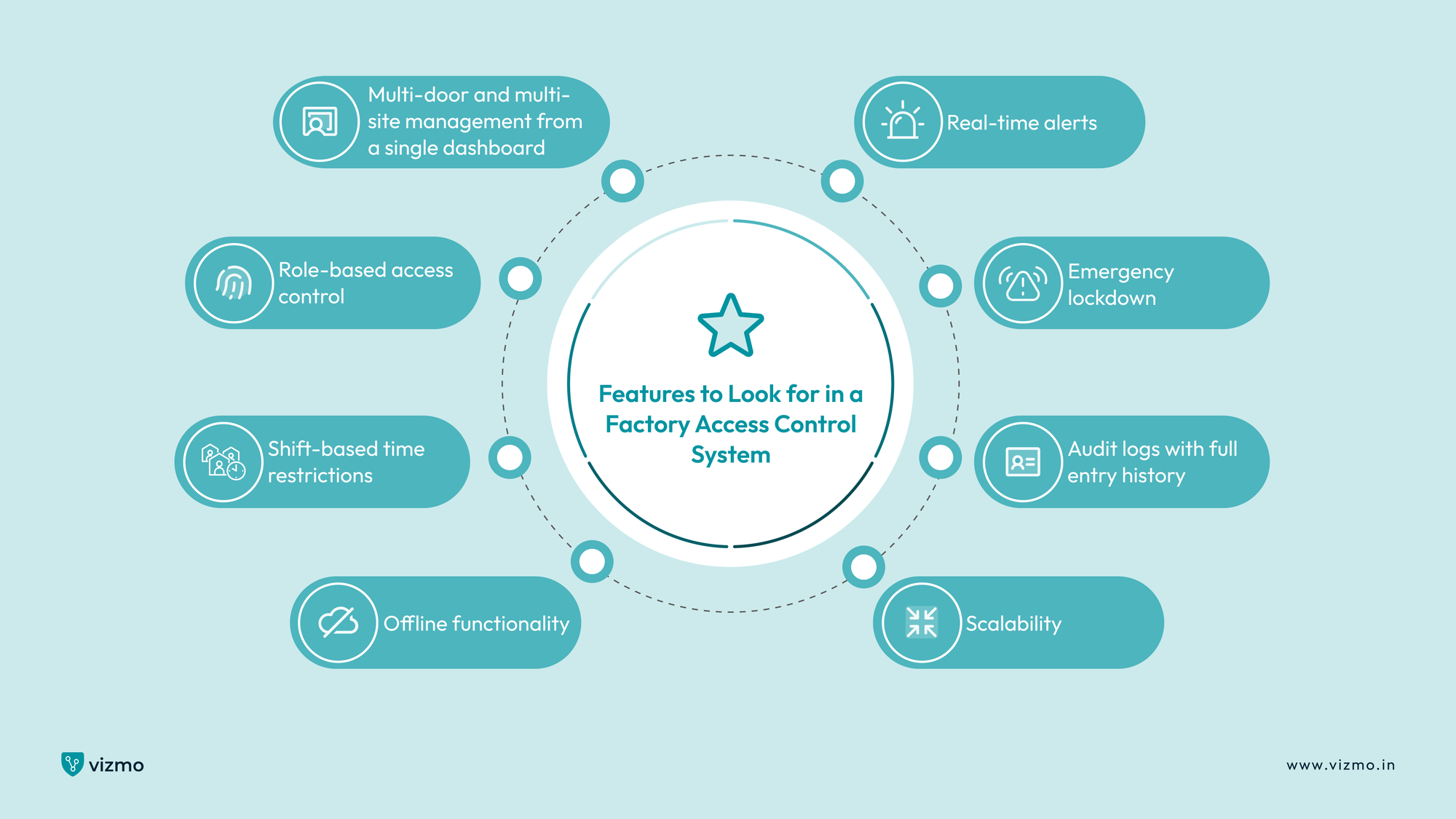
• Multi-door and multi-site management from a single dashboard — essential for factories with multiple buildings or campuses
• Role-based access control — permissions assigned by job function, not individually, so onboarding a new employee takes minutes
• Shift-based time restrictions — credentials activate and deactivate automatically based on the employee's scheduled hours
• Offline functionality — the system continues to operate and log entries even if the network connection drops
• Real-time alerts for unauthorized attempts, tailgating events, and doors held open beyond the allowed time
• Emergency lockdown — triggered remotely from the dashboard or on-site, securing all doors within seconds
• Audit logs with full entry history — searchable by person, door, time range, or department
• Scalability — the system should handle additional doors and users without requiring a hardware overhaul
Challenges in Factory Access Control Implementation
Most implementation challenges are predictable — and manageable with the right approach.
• Large, rotating workforces — factories with 500+ employees across multiple shifts require careful planning of role-based permission structures before deployment. Vizmo's bulk onboarding allows credential setup for large teams without individual configuration
• Harsh industrial environments — fingerprint readers can struggle with dusty or oily conditions. Face recognition and RFID readers are more reliable in these settings
• Network dependency — cloud-based systems require stable connectivity. Offline fallback mode ensures doors continue to function during outages and sync records when connection is restored
• Contractor and visitor volume — factories with high daily contractor throughput need pre-registration workflows to avoid gate congestion. Mobile credentials and pre-approved check-ins resolve this
• User adoption — employees unfamiliar with biometric systems may initially resist. Short onboarding sessions and clear communication about data use significantly reduce friction
How to Choose the Right Access Control System for Your Factory
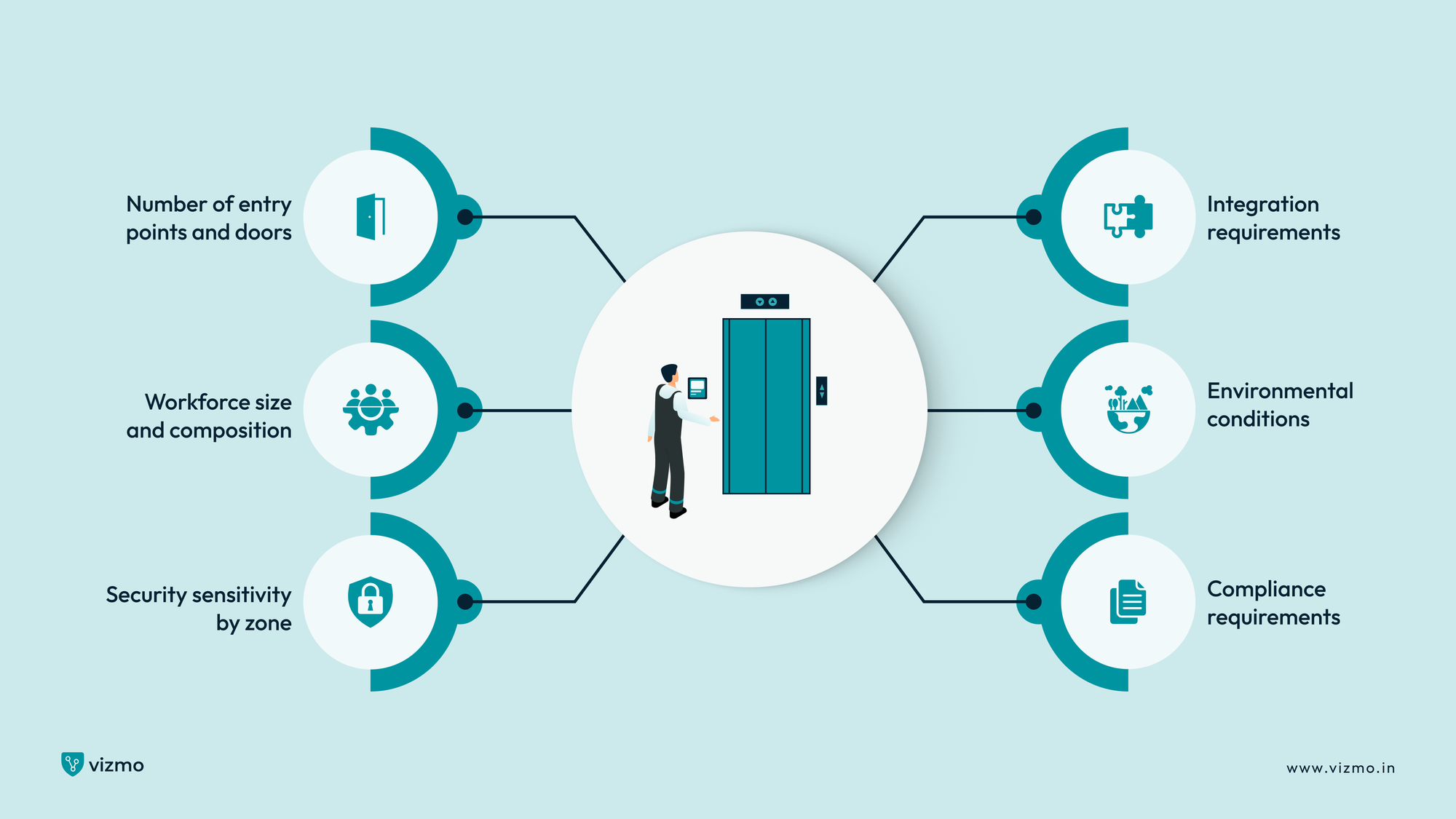
The right system depends on four factors specific to your facility:
• Number of entry points and doors — a single-gate factory has different requirements from a multi-building campus with 30+ controlled doors
• Workforce size and composition — a facility with 200 permanent employees has a simpler credential management challenge than one with 200 employees plus 100 rotating contractors
• Security sensitivity by zone — if your facility has restricted areas (chemical stores, R&D, server rooms), you need zone-level access rules, not just perimeter control
• Integration requirements — if you already run an HRMS, attendance system, or CCTV platform, the access control system needs to connect with them cleanly
• Environmental conditions — fingerprint systems require clean-hand conditions; face recognition works in dusty, gloved, or PPE-heavy environments
• Compliance requirements — factories subject to regular audits need systems that generate structured, exportable logs by default, not as an add-on
Vizmo's factory access control system is built to handle all of the above — from single-site SMEs to multi-location manufacturing enterprises — with deployment support that includes integration setup and workforce onboarding.
Future Trends in Factory Access Control
• AI-based facial recognition is improving accuracy in variable lighting and partial occlusion conditions, making it viable for outdoor factory gates and poorly-lit production floors
• Cloud-based access control systems are replacing on-premise servers — updates, permission changes, and monitoring happen remotely without an on-site IT team
• Mobile credentials are expanding beyond visitors into permanent workforce management, particularly for factories with hybrid or flexible shift structures
• IoT integration is connecting access control with environmental sensors — a door opening in a restricted zone can trigger HVAC adjustments, lighting changes, or equipment shutdowns automatically
• Predictive security analytics are beginning to flag unusual access patterns — a credential used at an unexpected time or location triggers an alert before an incident occurs, not after
In Short
• A door access control system replaces manual gate registers and physical keys with digital credentials that log every entry and exit automatically — tied to an individual's identity, not a shared card
• Factories should match technology to environment: RFID for high-traffic general entry, biometrics for attendance-critical production floors, face recognition for high-security zones and PPE environments
• Role-based and shift-based access permissions mean a factory's security rules enforce themselves — no manual credential management required after initial setup
• Integration with HRMS, attendance systems, CCTV, and visitor management turns access control from a standalone security tool into the central nervous system of factory operations
• Vizmo's factory access control system supports face recognition, RFID, and mobile credentials across multi-site facilities — with audit-ready reporting built in
FAQs
- What is a door access control system?
A door access control system is a security system that manages who can enter specific areas of a facility using digital credentials — RFID cards, biometric scans, or facial recognition — instead of physical keys. It verifies identity, checks access permissions, unlocks the door if authorized, and logs the event automatically.
- Which access control system is best for factories?
For most factories, a combination works best: RFID at main gates for fast, high-volume entry; biometric fingerprint readers on production floors where attendance accuracy matters; and face recognition at high-security zones like chemical stores, server rooms, or R&D areas where credential sharing must be completely eliminated. Vizmo's system supports all three technologies on a single platform.
- Can biometric access control work in a dusty factory environment?
Fingerprint readers can struggle in environments where workers' hands are regularly contaminated with dust, oil, or chemicals — scan failure rates increase significantly. Face recognition is the more reliable alternative for factory floors, as it works without contact and is unaffected by hand conditions or standard PPE like gloves.
- What is the difference between RFID and biometric access control?
RFID uses a card or tag to authenticate entry — fast, but the card can be shared or lost. Biometric access control uses a physical characteristic unique to the individual, most commonly a fingerprint or face scan, meaning the credential cannot be transferred. Biometric systems eliminate buddy punching and unauthorized credential sharing entirely.
- Can access control systems integrate with attendance and HR systems?
Yes. Most modern factory access control systems, including Vizmo's, integrate with HRMS and attendance platforms. Entry timestamps feed directly into attendance records, role changes in HR automatically update access permissions, and terminations revoke credentials without a separate security admin step.
- What areas in a factory should have restricted access control?
Production floors, chemical and hazardous material storage, server rooms, control rooms, R&D labs, warehouses, and dispatch areas should all have controlled entry. The level of restriction — and the technology used — should match the risk: face recognition for high-security zones, RFID or biometrics for general production areas.
- What are the benefits of face recognition access control in a factory?
Face recognition eliminates credential sharing entirely since a face cannot be transferred. It works hands-free, making it practical for factory workers wearing gloves or carrying equipment. It is fully contactless, which matters in industrial environments where hygiene and surface contamination are concerns. And it processes entry in under a second, preventing bottlenecks at high-traffic entry points.